
Royal Heins International Floriculture Research Scholarship
Established in January 2026, the Royal Heins International Floriculture Research Scholarship Fund supports semester-long international research experiences that help students grow both scientifically and professionally.
Created through a generous commitment from Dr. Royal Heins, Professor Emeritus at Michigan State University and longtime industry researcher, the scholarship will be awarded annually to a U.S. citizen enrolled in a Ph.D. program in floriculture or controlled environment research at a U.S. or Canadian institution. Engineering and Al application to floriculture/greenhouse/controlled environment production will also be considered. To ensure students are able to take advantage of this opportunity in its first year, the inaugural deadline is May 1st,2026. Beginning in 2027, the deadline will align with other AFE graduate opportunities on February 1st.
This scholarship complements the student’s dissertation work by providing access to research opportunities, facilities, or expertise not available at their home university. Students must secure a host advisor at an institution outside the U.S. or Canada, reinforcing the Fund’s emphasis on global scientific collaboration.
Student Eligibility
- Must be a U.S. citizen currently enrolled in a recognized floriculture or controlled environmental Ph.D. research program at a U.S. or Canadian university/institution.
- Ideally, the applicant would have a defined research plan at the international institution that complements their current dissertation work. Preference will be given to students conducting research in some way associated with floriculture crops or crop production. Engineering and Al application to floriculture/greenhouse/controlled environment production will also be considered. If the student is past the research phase of their graduate studies, a proposal will be considered where the student shows the professional growth expected during the international experience prior to their graduation.
- Must have a confirmed host advisor at an institution outside the U.S. or Canada.
- Note: In exceptional cases, a domestic placement at a distinct US laboratory offering unique training unavailable at the home institution and unavailable at an international institution may be considered.
Application Requirements and Information
Submit your online application by clicking here. Be sure you have your CV/resume, dates of study, letters from your host and advisor, budget/cost document, and photo of yourself ready to upload. Student will also be asked to provide a summary of research and activities to be conducted, how it benefits the students’ professional development and the floriculture industry overall, and a description of future professional goals in floriculture.
Each award is expected to range from $30,000 to $35,000 and is designed to remove financial barriers that often limit international research experiences. Rather than being awarded directly to the student, funds are distributed to the student’s university with oversight from the major professor. The scholarship covers replacement costs for the student’s graduate assistantship during the semester abroad, a housing allowance at the international location, and a round-trip economy flight.
Please note: In exceptional cases, a domestic placement at a distinct U.S. laboratory offering unique training unavailable at the home institution and unavailable at an international institution may be considered.
Prior to starting the online application, please gather/prepare the following documents:
- CV/Resume – This should include listing of educational background and professional activities that provide information to evaluate student achievement and potential.
- Dates of Study – The student must specify the dates of travel which may start up to one year after the award is announced.
- Note: The effective start date of the scholarship depends on the applicant’s entry pathway. Students who earned their MS at their PhD study institution may begin the scholarship experience as early as immediately upon matriculation into the PhD program. Students entering from outside the institution or without a prior MS degree become eligible to begin the scholarship experience after the completion of two academic semesters.
- Budget/Cost Sheet – Please prepare a document outlining your projected costs and budget for your semester abroad. The breakdown of estimated costs should include stipend replacement, flight, and housing.
- Advisor Letter – The letter from your advisor should confirm the dates and purpose of your study, acknowledge that this program has been approved by your university, and confirm they will supervise your studies during this semester. This advisor will be contacted via email by AFE after you submit your application to provide their final approval.
- Host Letter– This should be a letter of invitation from your host/faculty member abroad agreeing to mentor the applicant for the planned semester and confirming the dates of study. The letter of support should be from the students’ current major professor indicating their willingness to continue home institution assistantship.
- Photo – Please submit a color photo of yourself to use for publicity purposes if you are awarded with this scholarship.
Post-Award Requirement – Recipients are required to submit a written summary report (or a blog) to AFE and a popular press article (e.g., for GrowerTalks or AFE newsletters) describing their experience and research outcomes upon their return. The report and the article must be delivered to the AFE office within 30 days of international experience completion.
About Dr. Royal Heins
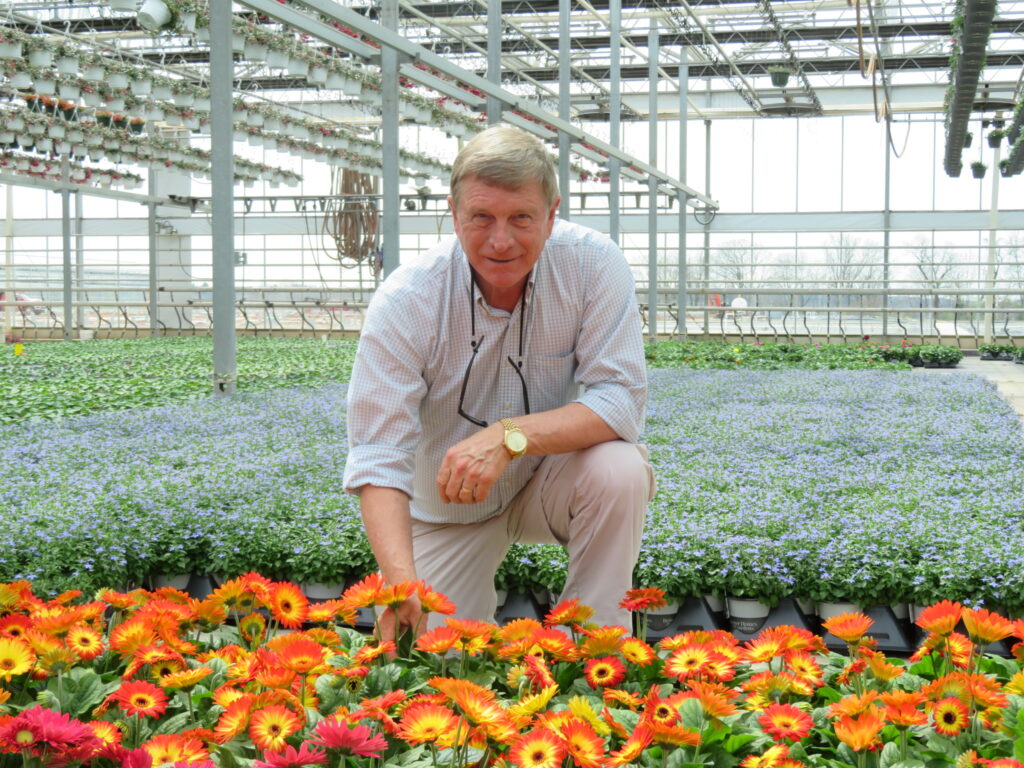
This scholarship reflects Dr. Heins’ long-standing belief in applied research, mentorship, and learning through experience. “My academic mentor, Dr. Harold F. Wilkins, believed deeply in the value of a global perspective. During the first week of my graduate studies in 1975, he departed on an around-the-world trip that included taking the Trans-Siberian Railway during the height of the Cold War. His example was eye-opening. He later invested in my professional growth by sending me to Europe to meet with international scientists — an experience that shaped my career,” reflected Dr. Heins.
Throughout his career in academia and industry, he emphasized pairing strong scientific foundations with real-world applications. Colleagues and industry leaders frequently note his influence on modern greenhouse production practices and on the many students he mentored.
“As a horticulture faculty member at Michigan State University, I strove to provide that same opportunity by sending my Ph.D. students to work in foreign laboratories for a semester. They invariably returned with a deeper appreciation of other cultures and new knowledge that enriched their research. Recognizing that not all faculty have the resources to fund these exchanges, I established this scholarship to help send American Ph.D. students abroad, ensuring they gain that vital cultural and scientific exposure,” continued Dr. Heins.

After joining the faculty at Michigan State University in 1978, Dr. Heins spent decades teaching crop production and greenhouse environmental physiology while mentoring undergraduate and graduate students. His research on flowering physiology, temperature responses, and decision-support systems helped establish practices now widely used in commercial greenhouse production. Over his academic career, he advised sixteen graduate students and authored or co-authored hundreds of scientific and industry articles, always emphasizing clarity, practicality, and application.
You can read more about his many achievements here.
.
.
.