
News
Nitrogen Fertilizer Needed to Grow Crops is in the Air We Breathe
December 16, 2025
By Professor Christian Nansen, University of California Davis and co-authors from his lab group: Postdoc Patrice Savi and graduate students Pamela Andrade and Yugeng Zou.
In this article, we provide insight into a solution to the global challenge of meeting future demands for nitrogen fertilizer. This article follows up on a virtual seminar in the 2025 Grow Pro Series by the American Floral Endowment, entitled: Plasma-Activated Water (PAW) for Floriculture Production. The seminar is available as a YouTube video here.
The Growing Demand for Fertilizer

With a growing human population, longer life expectancy, and living standards improving in many parts of the world, demands for more agricultural and horticultural products will increase in coming decades. Many of us scientists dedicated to applied solution-based teaching and research are directly and/or indirectly involved in projects addressing the existential question: how is an increase in demand for agricultural and horticultural products going to be met in ways that are both economically viable and environmentally sustainable?
And it should be noted that, the percentage of households in the US facing either low or very low food insecurity is steadily increasing, especially among certain demographics (Odoms-Young et al., 2024). So, the general need for agricultural and horticultural products is growing, but we are also facing the issue that food is already too expensive for some households to meet their daily needs. It is therefore clear that the global challenge is not only about producing more, it is also about producing it in ways that keep production costs low enough, so that vulnerable demographics in our society can afford to buy the groceries they need.
Food Security
Low food security has been defined as households in which the quality, variety and desirability of meals are reduced due to economic constraints, but the quantity of daily food intake is not substantially disrupted. Very low food security of a household implies that the daily food intake and eating pattern of a minimum of one household member does not meet daily caloric and nutritional requirements due to lack of food and financial burden.
At this point, you are maybe asking yourself – where is this going and what does food insecurity have to do with horticulture and ornamental crop production? Well, there are many connections, because production of food and ornamental crops compete for some of the same resources (space, labor, water, etc), and we are going to discuss one of them in some detail, fertilizer.
One very important prerequisite of increased production of agricultural and horticultural products is that growers have access to affordable and environmentally sustainable fertilizer – and where is that going to come from? And if production of agricultural and horticultural products will require more fertilizer, then producers of ornamental crops are likely going to face additional competition and increased costs. That is, unless we find other ways to produce fertilizer, and that is what this article is about.
The Current Fertilizer Demand and its Environmental Footprint
In 2022, it is estimated that global fertilizer consumption was about 188 million metric tons, with nitrogen-based fertilizers (excluding phosphate and potassium) accounting for about 58% or 96 million metric tons (Statistica, 2022). Focusing on nitrogen fertilizer (nitrate, ammonium, ammonia and nitric acid), almost 70% of non-organic nitrogen fertilizers are produced in four countries (In ascending order of importance: China, US, India, and Russia) – what does that mean for national sovereignty in individual countries? And how does it affect fertilizer prices when a handful of countries control the global market?
As inputs, production of non-organic fertilizers requires large amounts of fossil fuel and is therefore associated with a significant carbon footprint. Ammonium (NH3) is a nitrogen fertilizer precursor, and the total amount of carbon dioxide equivalents released into the atmosphere due to ammonia (NH3) production is about 400 Mt/ year, which is equivalent to 1.5 % of global greenhouse gas emissions (Martinez, 2022). Organic nitrogen fertilizers (manure, compost, etc) represent less than 10% (likely considerably less) of the global market. While important and likely to increase in adoption, these fertilizer products face insurmountable challenges with upscaling and integration into a wide range of cropping systems. In my research team, we are therefore looking in a different direction for a viable solution to the global nitrogen fertilizer challenge. In fact, we are not looking very far, because it is exceedingly abundant in the atmosphere all around us!
From Atmospheric Nitrogen Gas to Nitrate in Plasma-Activated Water (PAW)
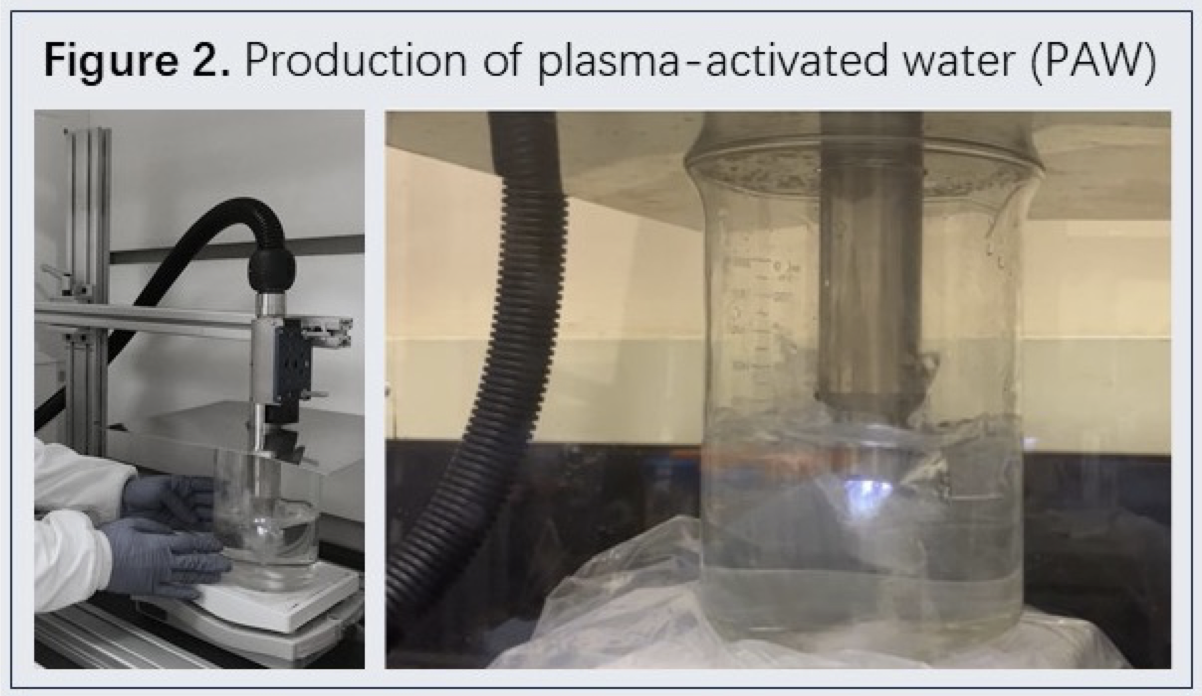
Here is a nerdy fact – the Earth’s atmosphere is about 4,000 trillion metric tons (or 4 × 10¹⁸ kg) of nitrogen gas (N₂). We mentioned earlier that the annual consumption of nitrogen-based fertilizers is about 96 million metric tons. So, if we turned the atmospheric nitrogen gas into fertilizer, how many years of demand could we meet? The answer is (4,000 trillion divided by 96 million) about 38 billion years! So, a rather reliable and long-term supply solution. And the way to take advantage of this enormous resource, atmospheric nitrogen gas, is to expose atmospheric air to a very high electric charge, because, as shown in Figure 2, this is when the magic begins…!
The atmosphere is 78.1% nitrogen (N2) [and 20.9% oxygen (O2)]. Only nitrogen fixating bacteria associated with the root zone of leguminous plants are able to convert atmospheric nitrogen into ammonia, which is reduced to ammonium (NH4+) in the soil and afterwards assimilated by plants. Generally speaking, plants can assimilate both ammonium and nitrate (NO3–). Using a high-energy technology, covalent N≡N bonds in atmospheric nitrogen and O=O in atmospheric oxygen can be broken, so nitrogen and oxygen molecules become free radicles and therefore highly reactive. If, as shown in Figure 2, immediately blown into water (H2O), then a wide range of oxygen and nitrogen compounds are generated, including nitrate. This process also changes many other characteristics of the water including its: pH, conductivity, and total dissolved solids, and it is referred to as “plasma-activated water”, PAW.
The Potential of PAW and its Potential Adoption by Growers
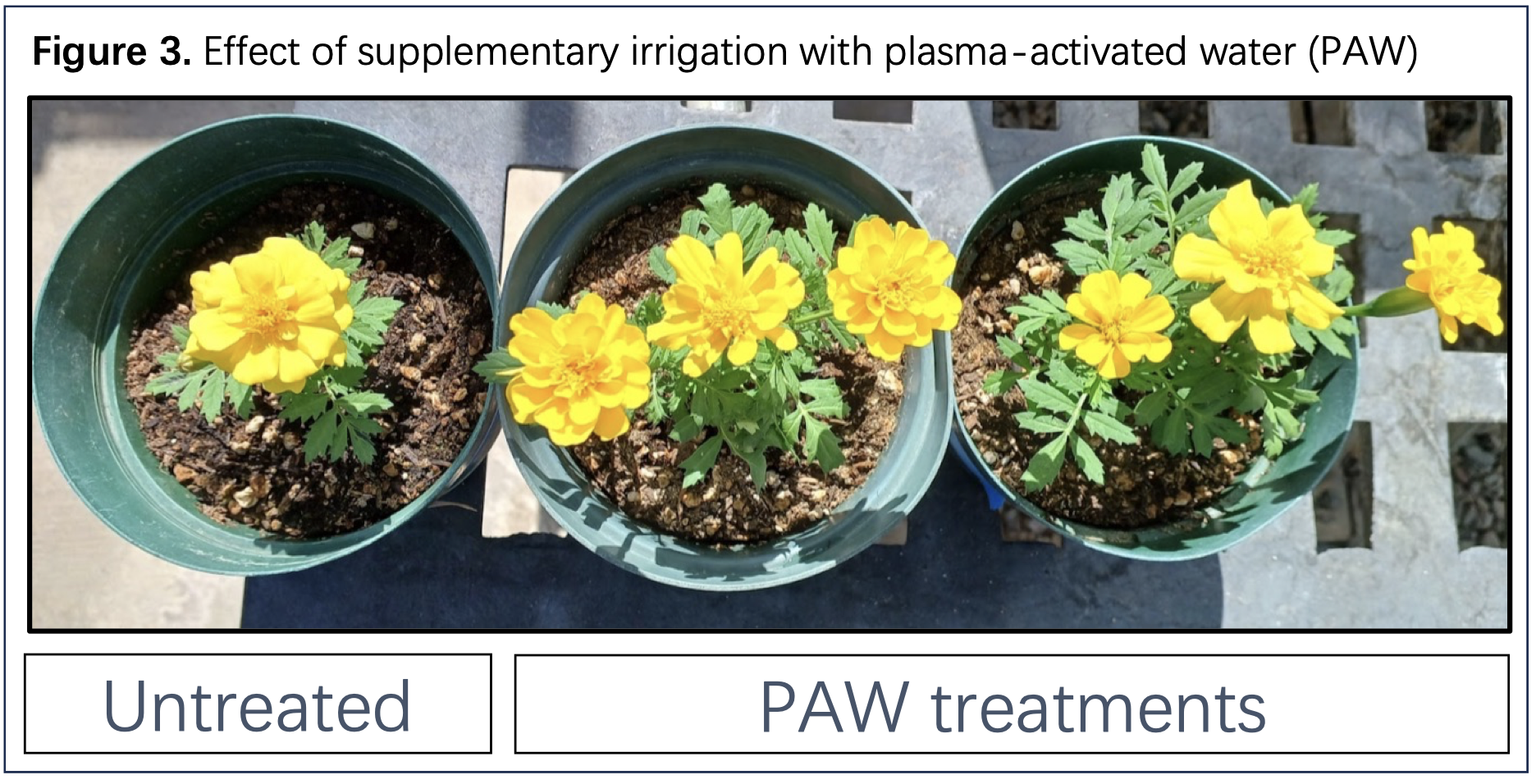
Figure 3 shows what we have observed across a wide range of crops – that plants tend to grow faster when irrigated with PAW. A growing body of literature supports this observation, and it is likely due to a range of direct and indirect effects by PAW. For readers interested in more information about these effects and the potential benefits of PAW, we recommend our recently published review article (Andrade et al., 2025).
In our recently published survey article, we found that growers are broadly interested in this innovative technology (Eylands et al., 2025), but we are unaware of companies selling PAW. Thus, growers with serious interest in this technology may look into purchasing systems. Several companies offer commercial systems to produce PAW – a simple internet search will quickly get you their names, and we are not in the business of promoting any of them in particular. Regarding legal implications of applying PAW to crops, we have investigated laws in California. As environmental rules and regulations tend to be among the strictest in the US, we thought they would serve as meaningful indicators of the “legal landscape”.
There are no law explicitly referring to PAW use in crop production as being prohibited or regulated under given statute. We used ChatGPT to look through publicly available regulatory, enforcement-action, and scientific documents for the last 5–10 years and found no evidence of any enforcement actions, regulatory decisions, or formal guidance by California Department of Pesticide Regulation (DPR) or California Department of Food and Agriculture (CDFA) that explicitly address use of plasma‑activated water in crop production. In short: there is no sign that regulators have treated PAW as a “pesticide” (or other regulated input).
We continue our applied research into PAW, and our website is regularly updated as we develop new outputs. We are grateful to the American Floral Endowment for their financial support of our research, and we are keen to provide future updates, in writing as well as through the seminar series.
Other funding sources include: USDA/Specialty Crop Multi-State Program, NIFA/ORG, USDA/ARS Floriculture, Nursery Research Initiative, and Western Sustainable Agricultural Research & Extension (WSARE).
References
Andrade PE, Savi PJ, Almeida FS, Carciofi BA, Pace A, Zou Y, Eylands N, Annor G, Mattson N & Nansen C (2025) Plasma-activated water as a sustainable nitrogen source: supporting the UN Sustainable Development Goals (SDGs) in controlled environment agriculture. Crops 5: 35.
Eylands N, Yue C, Wang Y, Kaczmar N, Andrade P, Savi P, Nansen C, Annor G, Carciofi B & Mattson N (2025) Greenhouse and nursery producers have optimistic outlook toward adoption of plasma-activated water in young plant production. HortTechnology 35: 710-718. doi:10.21273/horttech05689-25.
Martinez PL (2022) Techno-economic analysis of a solar ammonia and fertilizer production: Technical University of Denmark.
Odoms-Young A, Brown A, Agurs-Collins T & Glanz K (2024) Food insecurity, neighborhood food environment, and health disparities: state of the science, research gaps and opportunities. The American journal of clinical nutrition 119: 850-861.
Statistica (2022) Global consumption of agricultural fertilizer from 1965 to 2022, by nutrient, Vol. 2025.


