
News
Surveying Root Rot Species in Commercial Floriculture Production in Southern California
June 24, 2026
By Ana M. Pastrana, Kayleigh Lampe, Gerardo Spinelli, and Johanna Del Castillo
UC-ANR and UC-Davis
In 2024, California ranked second nationally in floriculture sales at $1.03 billion, following Florida at $1.13 billion, together accounting for 32% of all U.S. floriculture sales. The total value of floriculture sales in the United States reached $6.71 billion in 2024, with covered production area totaling approximately 90 million m² nationally. Many diseases pose significant challenges in nursery and greenhouse systems, including root and crown rot caused by various Phytophthora species and other oomycetes. Managing diseases caused by these oomycetes remains a persistent issue in ornamental production due to their complexity and effective dispersal through water. The movement of plant material between production areas facilitates the introduction of these pathogens, and the greenhouse environment offers conditions that favor their growth. Additionally, the use of recycled irrigation water in these facilities provides ample opportunities for the dispersal of motile zoospores. Furthermore, year-round production in greenhouse facilities ensures a continuous supply of new hosts for infection. The result is significant crop losses and heavy reliance on chemical fungicides, products that are increasingly costly, subject to regulatory scrutiny, and only partially effective.
Expanding research on these oomycete pathogens has garnered renewed interest within landscape and ornamental plant pathology, particularly due to the wide range of host plants affected and the discovery of new species. This increased interest has led to surveys of nursery and greenhouse facilities in some states; however, no surveys have been done yet in California, one of the major floriculture producers in the country. With support from the American Floral Endowment, our research team at the University of California (Cooperative Extension and Davis) is working to address that. Preliminary results of a survey on three southern California nurseries revealed a high diversity of oomycete pathogens within Southern California floriculture operations. The surveys of these three commercial facilities — representing large-scale container ground-level and cut-flower production systems — resulted in the recovery of 16 oomycete species from 28 plant host species (Figure 1). Over 50 isolates are now preserved in the Del Castillo Lab culture collection at UC Davis.
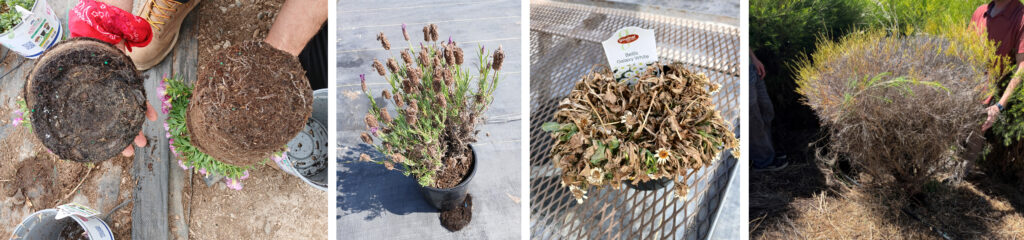
Figure 1. Symptomatic gerbera (left), bellis (center-left), lupinus (center-right) and waxflower (right) with root rot, wilting, and foliar necrosis.
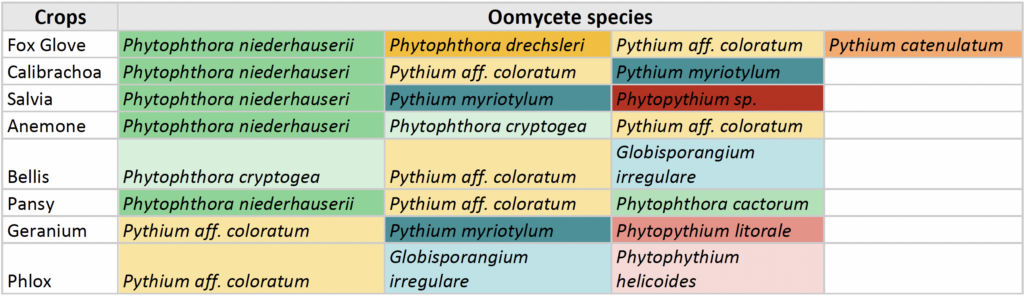
Among the pathogens identified, Phytophthora niederhauserii and Pythium aff. coloratum emerged as the most prevalent and host-diverse species, recovered from a broad range of crops across multiple facilities. The hosts with the highest rates of oomycete recovery include anemone, salvia, pansy, geranium, foxglove, phlox, calibrachoa, and bellis — common and commercially important crops throughout the state (Table 1).
Table 1. The eight floriculture crops with the highest rates of oomycete recovery and the pathogens associated with each.
Building on these findings, pathogenicity assays are currently underway to confirm which pathogens are truly causing disease in the field. Isolates of Phytophthora niederhauserii, P. cryptogea, P. cactorum, and selected Pythium and Phytopythium species — chosen based on their high recovery rates during the survey — are being evaluated on different hosts. Disease development is monitored weekly, and upon completion of each trial, symptomatic tissue will be plated to re-isolate the inoculated pathogen and fulfill Koch’s postulates.
This research is ongoing. As the study continues, the researchers will build on these findings to gain an even deeper understanding. We look forward to sharing additional results and insights with you as the research progresses!


