
News
Beyond a Lifetime’s Work
December 10, 2025
Dr. Terril and Cathy Nell’s Support for AFE’s Legacy Circle is a Culmination of Passion and Lessons from Around the World
He was simply following his grandmother’s instructions.
“Here is a packet of seeds. Go rough the ground up over there and sprinkle these over the top. Let’s see what happens.”

The marigolds planted in his grandmother’s garden flowered. But what also started to grow was a glimpse of the future for a young boy from the south. That day symbolized the beginning of a rich career in the floriculture industry for Dr. Terril Nell, including time spent serving AFE as the Research Director.
Now, the retired college professor and industry advocate, along with his wife, Cathy, are looking to the future of the industry by encouraging planned gifts to our Legacy Circle.
Home and Abroad
Terril admits he knew very little about horticulture when he started working toward his undergraduate degree at Auburn University in Alabama, where he met Cathy.
“I had grown up mowing lawns, and a friend of mine up the street had camellias and introduced me to that. My grandmother was always a great gardener,” he said. “So, I went through my undergraduate degree thinking I was going to go into landscaping.”
But his career plans veered slightly once he reached graduate school at North Carolina State University. There, he met a mentor, Roy Larson, who had a reputation as a leading floriculture expert in the country. It is where Terril discovered greenhouse crops, and a passion for them followed him through the next leg of his journey – Michigan State University, where he earned his PhD and embarked on what would become a 35-year career as a professor at the University of Florida. In that time, Terril noted he had been connected with AFE for support, including research funding.
About 11 years into his role of educating young minds about floriculture, Terril took a sabbatical to become even more immersed in the industry. This time for a research project and to write a book.
“At the time, I didn’t have all the data to write it. Industry members were asking where I could go to get the research to do the work,” he said. “The only place really was in the Netherlands. And so, they sent us there for six months.”
With part of the funding coming from the Endowment to travel, Terril and his family temporarily moved to the Netherlands, where he conducted potted plant postproduction research, toured greenhouses, traveled to study floriculture in nearby regions, and became immersed in the education and culture of the Netherlands. The result was Terril’s book, “Flowering Potted Plants: Prolonging Freshness” by Ball Publishing.
“It’s been a great opportunity for us as a family and me as an individual,” said Terril.
With the future of his students always top of mind, Terril returned to his position with the University of Florida with a mission. He started organizing trips to Europe to expose students to floriculture operations in Denmark, the Netherlands, France, and Italy.
“I saw when we were in the Netherlands that we did not fully understand what the Dutch were doing in floriculture production and the Dutch really didn’t know what we were doing,” he said. “I thought there needed to be an exchange of information, and why not involve the students?”
Cathy said the travel was imperative, especially at a time in history when fax machines were barely making a breakthrough. There were no virtual meetings, no real way to connect other than being there in person to learn.
“There was no opportunity to interact like there is today internationally, without leaving your home. And we just found it to be such a tremendous experience, such a learning experience that we thought it was important to pass that on to students,” she said.
More Lessons Back Home

While Terril had been involved with AFE prior to his international travels, when he returned to Florida, he was inspired to become engrossed in the industry. He eventually got involved with the Society of American Florists to lobby for more industry research funding from the federal government. He and other advocates pushed lawmakers on Capitol Hill and accomplished the goal. The funding through the ARS Floral and Nursery Research Initiative, he noted, is still available today.
Research has been an integral part of Terril’s teaching career. He learned early on that the most successful way to advance the industry was to carefully blend the two. It was a passion that revolved around how to do research to benefit the industry while also teaching the next generation to be successful.
“To do both of these, you really need to be talking to people working in the industry. You need to know what the priorities are. What they need. If you launch a research project around industry needs and fund a graduate student to do the work, there is value in that, and the support will be there,” he said.
When Terril retired from the University of Florida in 2011, he didn’t leave the industry. Not yet ready to give up a passion for more, he was doing some consulting when we approached him about overseeing our research program. He spent more than a decade overseeing research projects and working with faculty and industry members. During his tenure as Research Director with AFE, Terril was also instrumental in raising $1.5 million for a program dedicated to combating pests and diseases.
When it was time for Terril to officially retire from the industry in 2023, he did so hesitantly. His time teaching and being a part of AFE created fond memories that he holds dear. From his home in North Carolina, he and Cathy enjoy watching the organization continue to thrive, noting that the creation of Sustainabloom was a crucial development for the industry, and they are happy to see it being so enthusiastically accepted.
“It is another example of what can happen when we listen to the industry members,” said Terril.
Eye on the Future
Cathy said as she and Terril look back over a 50-year career, their perspective has turned to noticing the pivotal moments that made a difference. That is why the couple highlights the importance and value of AFE’s Legacy Circle.
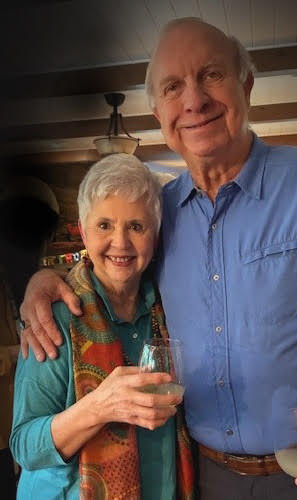
“AFE has played a big part in the opportunities and experiences that Terril has had in his career,” she said. “We all have a duty to pay back and make sure that other young people, as they start their career, have opportunities such as we had. It’s also an opportunity to say thanks.”
Terril said he feels fortunate as a university researcher to have had the support of AFE grant funding to add a graduate student and additional staff when he would have otherwise not been able to do so.
“This industry is in your blood. What happens here is that you see the benefits of what you are accomplishing, and you want to share that with others,” he said.
“Commitments to the Legacy Circle provide a way for those who have found success in this industry to pay it back. I think those of us who choose to do so see possibilities for the future, and that’s an important reason to get involved.”
By Carla Dempsey


